
Tickets to Palazzo Pitti
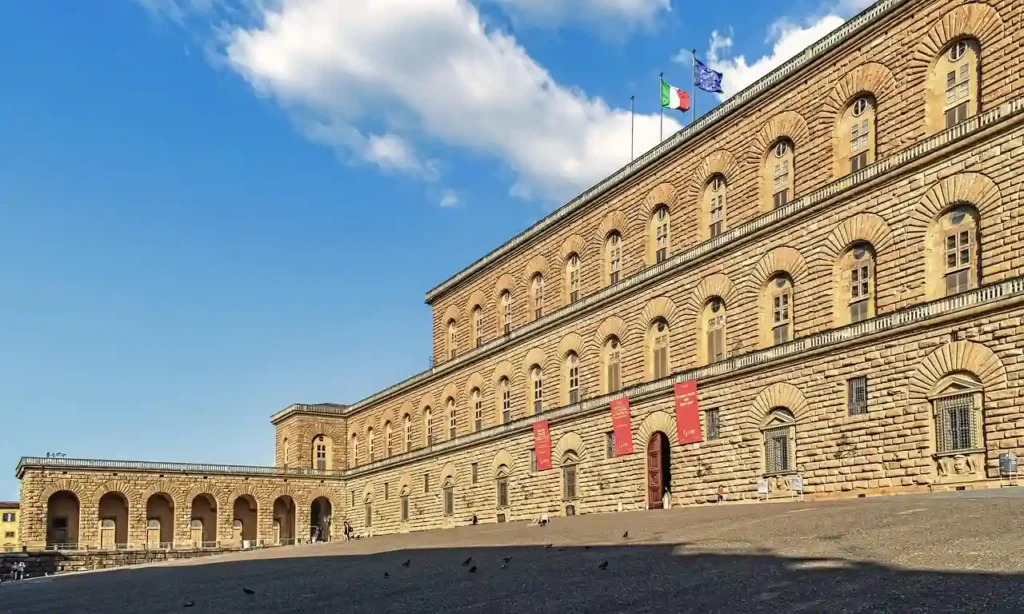
Palazzo Pitti tickets allow access to the museum complex, the art galleries, the historical rooms, and the Boboli Gardens. Travelers book reservations online to secure entry to this Florence monument.
Support when you need it
Customer service to help you with all your needs from 8:00 a.m. to 7:00 p.m.
Fast and online booking
Choose the best option for your needs and preferences and avoid the lines.
Top attraction in the city
Discover Florence’s Pitti Palace and step into centuries of history of the Florentine dynasties.
Book your ticket to Pitti Palace
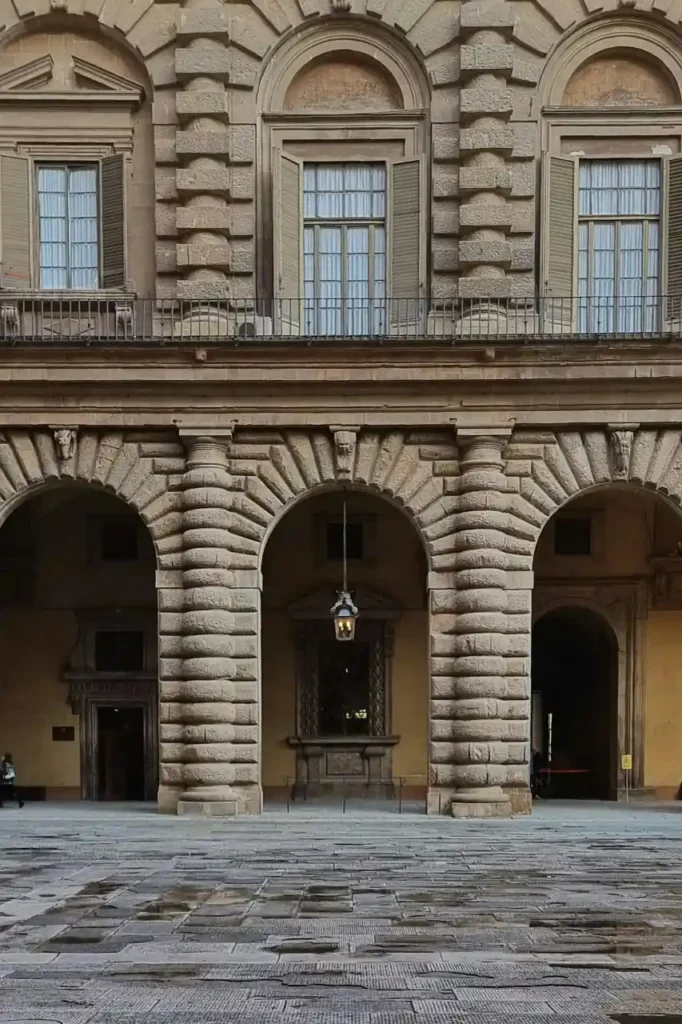
Travelers can buy the Palazzo Pitti tickets to guarantee admission to the main site, which houses art galleries of international relevance. By acquiring tickets online, visitors obtain access to the Boboli Gardens, the Palatine Gallery, the Royal Apartments, the Gallery of Modern Art, and the Museum of Costume and Fashion. Additionally, these tickets include the possibility of touring the rooms that served as residences for three dynasties:
- The Medici: a powerful family of bankers and patrons who governed Florence and drove the Italian Renaissance.
- The Lorraines: the European noble house that succeeded the Medici in the Grand Duchy of Tuscany and ruled until the unification of Italy.
- The Savoy: the royal dynasty that led the Italian unification and reigned in the Kingdom of Italy from 1861 to 1946.
The online reservation process also allows the selection of a specific time slot, which speeds up entry by avoiding long waits at the Palazzo Pitti ticket office. In this way, access to the palace is more efficient and visitors can save time.
What can you see with your Palazzo Pitti ticket?
The Palazzo Pitti constitutes an architectural and artistic complex that represents the power of the great ruling families of Tuscany. When visiting the Pitti Palace, the public finds collections that span from the Renaissance to the 20th century, distributed in rooms decorated with Baroque frescoes and period furniture. These are some of the most relevant areas of the palace:
Boboli Gardens
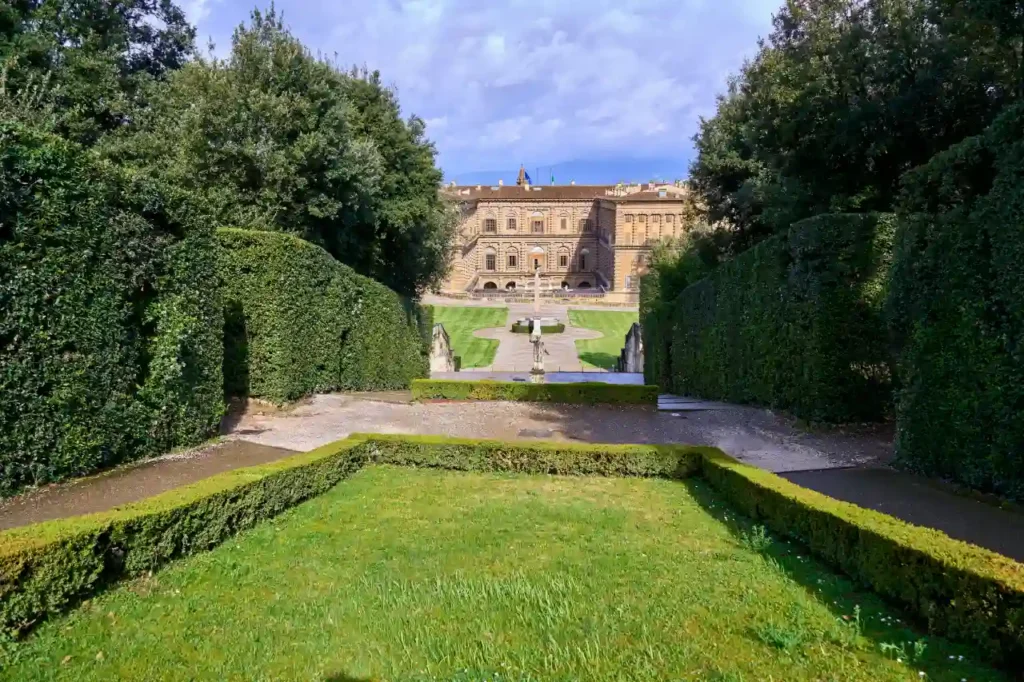
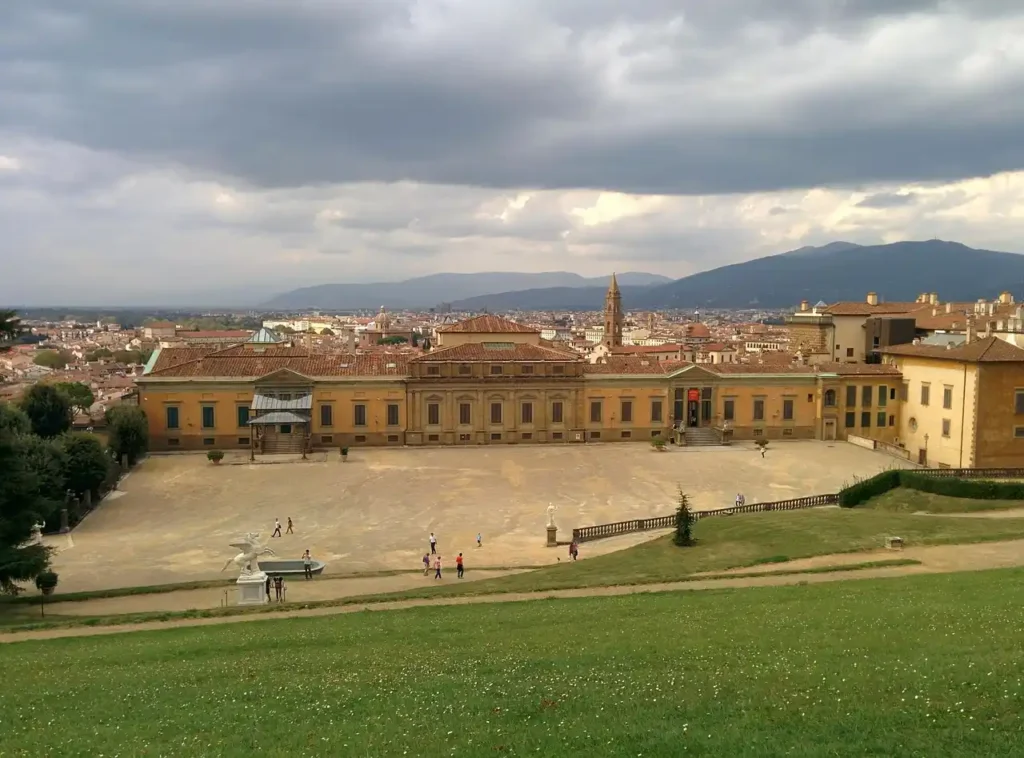
The Boboli Gardens occupy the area directly behind the Palazzo Pitti in Florence. The Medici family established the layout during the sixteenth century. This site functions as an open-air museum and contains a collection of sculptures from various periods.
Visitors find the Neptune Fountain and the Ocean Fountain within the grounds. The design incorporates gravel paths, stone statues, and fountains. The Grotto of Buontalenti houses artwork and architectural features. Large stone walls and manicured hedges define the perimeter of the space.
Palatine Gallery
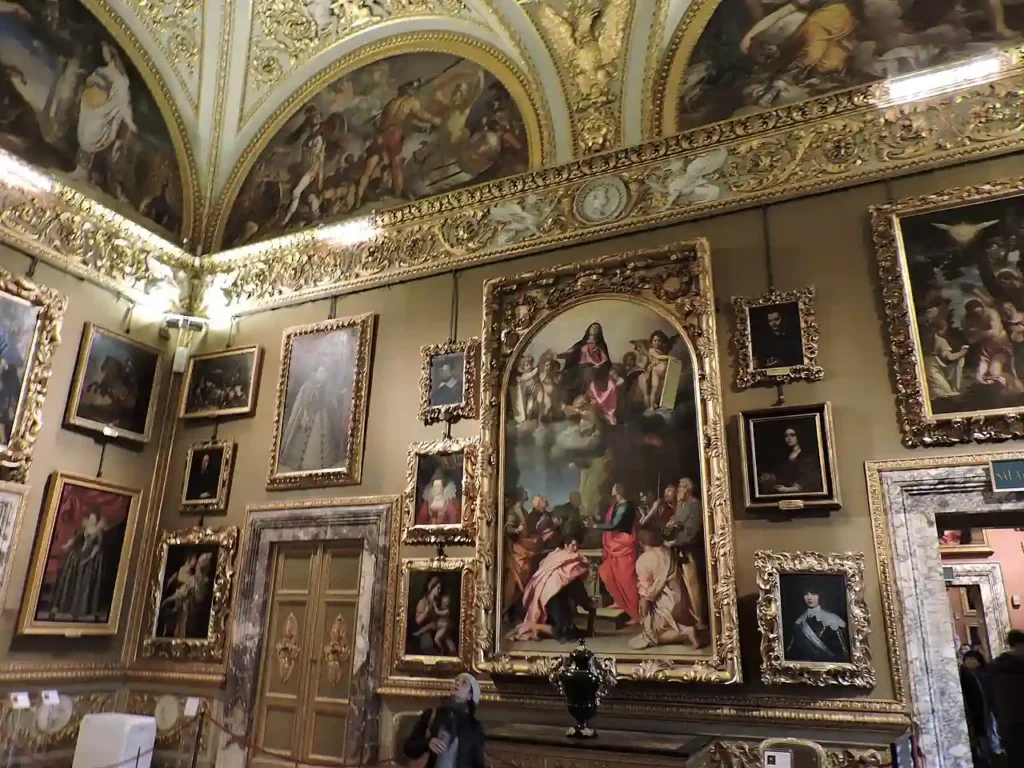
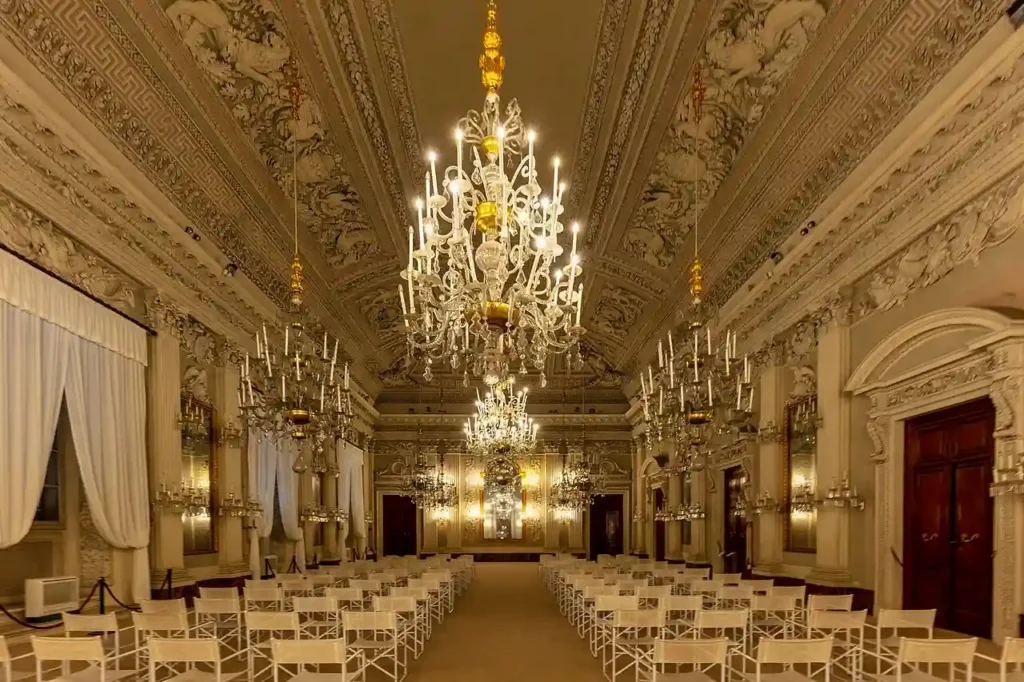
The Palatine Gallery occupies the main floor of the Palazzo Pitti and displays a private collection of paintings arranged according to 17th-century aesthetic criteria, not chronological ones. This section holds global importance as it houses the largest concentration of Raphael’s works in the world, including masterpieces such as the “Madonna della Seggiola” and “La Velata.”
The walls feature silk coverings and carved frames that complement the works of artists like Titian, Rubens, and Van Dyck. The arrangement of the paintings on several levels, just as the original princely collections did, offers the visitor a total immersion experience in the splendor of Baroque collecting. It is a fundamental place to understand the artistic wealth accumulated by the Grand Dukes of Tuscany over the centuries.
Photo: “Galleria Palatina, Palazzo Pitti, Florence” by Ham II.
Royal Apartments
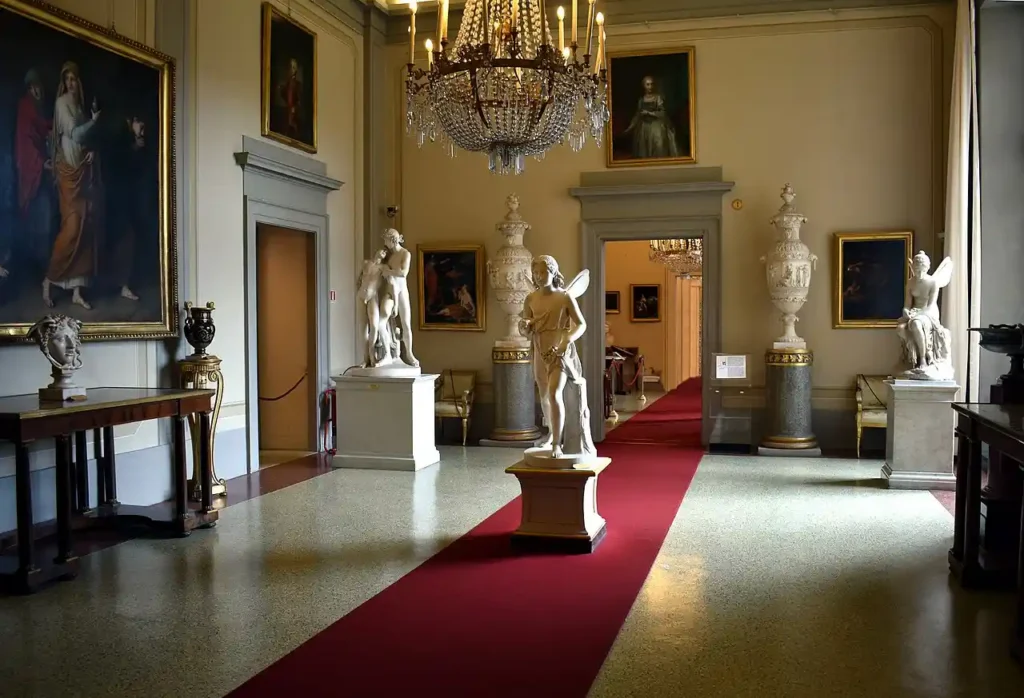
Adjacent to the gallery are the Royal Apartments, a set of 14 rooms that show the evolution of decorative taste from the Medici period to the unification of Italy. These spaces are essential for understanding the daily life of royalty, preserving personal objects, high-value historical tapestries, and furniture that spans several centuries of European history.
During the visit, one can appreciate the rooms that the Lorraines and later the Savoy dynasty inhabited when Florence was the capital of the Kingdom of Italy. Each room features decoration with great historical rigor, highlighting the White Room for its stucco decoration and the Audience Rooms which preserve original frescoes. Walking through these apartments allows the visitor to connect with the political and social history of Italy through high-society interior design.
Photo: “Sala Bianca, Galleria Palatina, Palazzo Pitti, Florence, Italy” by Poco a poco.
Museum of Costume and Fashion
Located on the second floor of the Palazzo Pitti, this gallery offers an exhaustive view of Italian art from the late 18th century to the first decades of the 20th century. The collection stands out for its section dedicated to the “Macchiaioli,” a movement of Tuscan painters who preceded Impressionism, represented by artists such as Giovanni Fattori and Silvestro Lega.
The rooms, which the Lorraine family previously used, provide a natural light context that highlights neoclassical sculptures and landscape paintings. The importance of this collection resides in its capacity to document the transition from academicism toward the new Italian artistic vanguards.
Photo: “Palazzo Pitti Galleria Arte Moderna” by Seauton.
Museum of Costume and Fashion
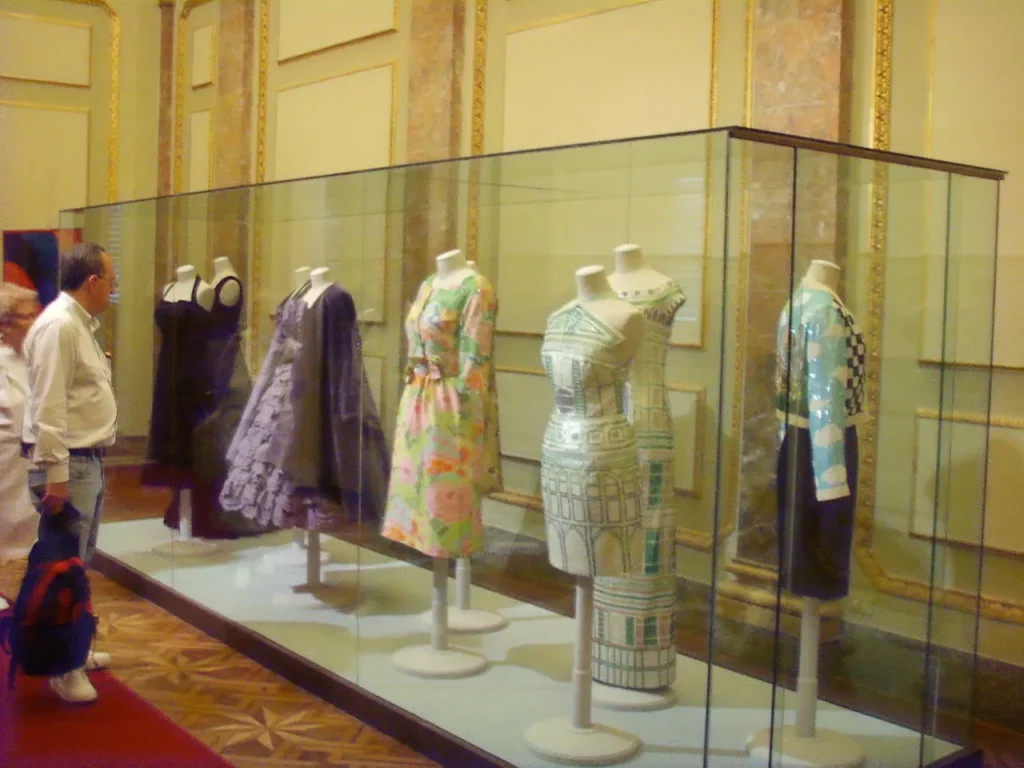
This museum, located in the Palazzina della Meridiana within the Palazzo Pitti, is the first Italian state institution dedicated to the history of fashion. The collection contains more than 6,000 pieces including ancient clothing, accessories, and theatrical costumes of great documentary relevance.
Among the most prominent pieces are the 16th-century funeral costumes belonging to Cosimo I de’ Medici, his wife Eleanor of Toledo, and his son Garcia. The exhibition is fundamental for understanding the technical evolution of textiles and the role of clothing as a symbol of social and political status throughout the centuries in the Florentine court.
Photo: “Galleria del Costume, Firenze” by Sailko.
What should you know before visiting the Palazzo Pitti?
Visiting the Palazzo Pitti requires adequate planning due to its size and security regulations. It is recommended to prioritize booking in advance to avoid lines and to consider the following points:
- Access with backpacks and other items: The staff prohibits entry with bulky backpacks, long umbrellas, or tripods. The palace provides a free cloakroom service.
- Dress code: No strict formal code exists, but the administration requests appropriate attire out of respect for the historical and artistic character of the place. Regarding the Boboli Gardens, the use of comfortable and athletic footwear is recommended, as the terrain features steep slopes and gravel paths in certain parts that make movement difficult with formal footwear.
- Food: The consumption of food is prohibited in the monumental areas of the garden to preserve the cleanliness and condition of the monuments.
- Animals: The entry of domestic animals is not allowed, with the exception of certified guide dogs for people with disabilities.
- Available services: The site has a cafeteria, a specialized bookstore, nursing rooms, and restrooms in the basement and at the entrance on the right side of the courtyard.
- Accessibility: The Palazzo Pitti is accessible for people with reduced mobility through elevators that connect all levels of the galleries. However, due to the slopes of the terrain, there are certain areas of the Boboli Gardens that are not accessible to people in wheelchairs.
- Photography: Visitors can take photographs without flash and without professional equipment, only for personal and non-commercial use.
- Booking in advance: Is recommended, especially during the high season months (April to October).
Plan your visit in advance
To optimize time in Florence and Palazzo Pitti reservations, it is fundamental to know the logistical details of the monument, such as its schedule, opening or closing days, and more:

Opening hours
The Palazzo Pitti operates from Tuesday to Sunday, opening at 08:15 and closing at 18:30. This schedule provides access to the Palatine Gallery, the Royal Apartments, the Gallery of Modern Art, and the Treasury of the Grand Dukes.
The Boboli Gardens open from Monday (excepting the first and last Monday of each month) to Sunday starting at 8:15. The closing time varies according to the season.

Closing days and special hours
The monument remains closed every Monday, as well as on January 1 and December 25, 2026. Currently, visits to the mezzanine of the Treasury of the Grand Dukes are suspended until further notice.
One can anticipate extraordinary openings during holiday weekends or specific cultural dates in Italy, which the administration announces in advance on the official Palazzo Pitti website.
Where is the entrance?
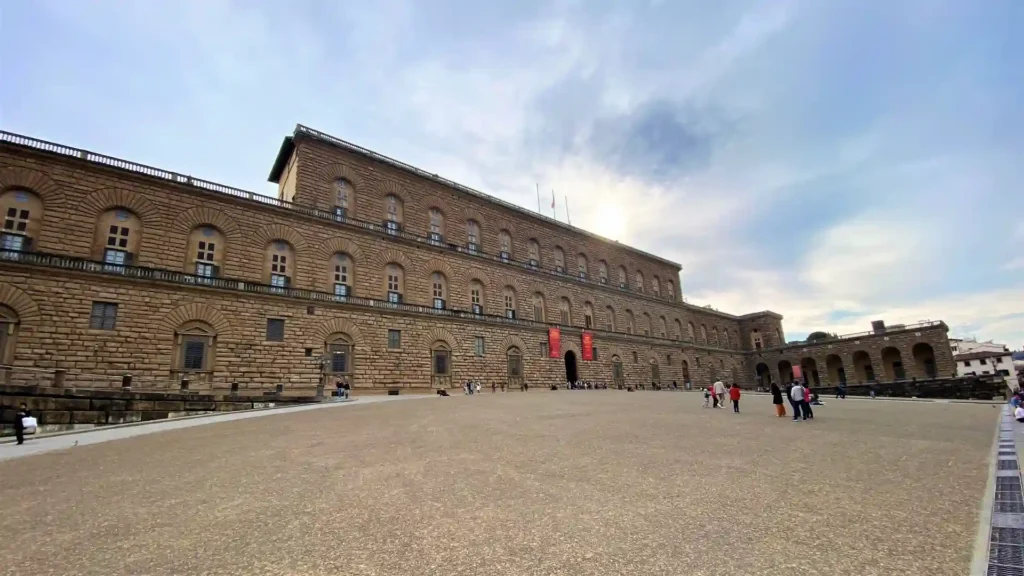
The main entrance is located at Piazza de’ Pitti, 1, 50125 Firenze FI, Italy. Access occurs through the large central portal that faces the square, where the security controls and the validation point for Palazzo Pitti tickets are located.

How to get there?
The Palazzo Pitti is accessible on foot from the historical center by crossing the Ponte Vecchio.
Additionally, one can reach it using different means of transport, except for the metro, as Florence has no metro lines:
- By bus, lines 11 and D have nearby stops.
- Access by private car is limited due to the ZTL zone, but nearby parking lots like Oltrarno exist.
- A taxi can drop off passengers directly in the square.
- By train, the Santa Maria Novella station is a 20-minute walk away.
Accessibility
The Palazzo Pitti is a space adapted for users with reduced mobility; in fact, the site features ramps and elevators. According to a testimony from a person on Facebook: “we were at the Palazzo Pitti and there are elevators. You will be able to visit all floors.”
Additionally, visitors with disabilities or special needs have priority access to the museum entrance. The venue also offers a wheelchair rental service for visitors who require it. It is not necessary to book or pay deposits; it is a free service.
However, The Boboli Gardens present challenges for visitors with limited mobility. The terrain consists of steep slopes and gravel paths.
FAQs about the Pitti Palace
Yes, it is highly recommended to make a prior reservation to secure the entry time and avoid long waits at the physical ticket office of the palace.
Yes, its collections and its architecture justify it. A user on Reddit states: “The Palazzo Pitti has a lot of things to offer,” while other users highlight on the same platform that “the apartments are worth seeing if you’re into interior design” and that “there are lots of great paintings,” one user even asserts that “It’s one of my favorite museums in Florence for sure.”
The best time is first thing in the morning, at 08:15, or during the early hours of the afternoon, to avoid the massive influx of tourist groups.
Given the magnitude of the galleries and the interior museums, a Reddit user suggests that one requires approximately “around 6 hours” for an exhaustive tour of all sections of the Palazzo Pitti and the Boboli Gardens.
The line varies according to the season and the time of arrival. In this regard, a user on Reddit comments: “I showed up around mid day and there was a bit of a wait but not too bad.”
In the immediate vicinity are the Boboli Gardens, the Church of Santo Spirito, the Ponte Vecchio, and the Vasari Corridor, all located in the Oltrarno neighborhood.
Yes, as we mentioned earlier, the Palazzo Pitti possesses an adequate infrastructure for people with reduced mobility, including elevators and assistance staff.
Entry is free on the first Sunday of each month and on specific commemorative dates designated by the Italian Ministry of Culture.
Yes, it is worth it for its historical and artistic value. As a user on Reddit states: “It is totally worth it,” and further ensures that the views from the Bardini Garden “are my favorites in all of Italy.”
The Piazza Pitti entrance is the most used, but the Porta Romana entrance is more convenient if arriving by transport.