
What to see at Pitti Palace?
Palazzo Pitti, the largest of the Florentine palaces, holds five museums under one Renaissance roof in the Oltrarno, on the south bank of the Arno. The Palatine Gallery preserves the Medici picture collection in its original baroque arrangement, while ground-floor galleries cover the Treasury of the Grand Dukes and Russian icons, and the second floor moves through fashion history and 19th-century painting. The Boboli Gardens climb the hill behind.
What is Palazzo Pitti and why visit it?
Palazzo Pitti is a Renaissance palace whose principal block covers 32,000 square metres on the slopes of the Boboli hill, a short walk south of the Ponte Vecchio. Luca Pitti, the 15th-century Florentine banker, broke ground on the original residence in 1458; the building was sold to the Medici family in 1549, when Eleonora di Toledo, the wife of Cosimo I de' Medici, brought it into the Grand Ducal court. The palace then served three dynasties in succession, the Medici until 1737, the House of Habsburg-Lorraine from 1737, and the House of Savoy from 1865, when Florence briefly became the capital of unified Italy. King Victor Emmanuel III donated the palace and its collections to the Italian state in 1919, and the complex now functions as the largest museum cluster in Florence.
Palazzo Pitti is also part of the Historic Centre of Florence, inscribed on the UNESCO World Heritage List in 1982 under five separate criteria, an international anchor that few competing palaces in the city share. The reason to step inside is the breadth: five distinct museums, original Medici picture-hangings on damask walls, ceremonial apartments used for three centuries of court life, and direct access to one of the most influential Italian gardens of the Renaissance.
Book your ticket in advance to ensure smooth entry to the palace or the gardens.
The five museums of Palazzo Pitti at a glance
Palazzo Pitti houses five permanent museums, distributed across three floors:
- Ground floor. The Treasury of the Grand Dukes (formerly the Silver Museum) occupies the Medici summer apartments and the mezzanine; the adjacent rooms hold the Museum of Russian Icons and the Palatine Chapel.
- First floor (noble floor). The Palatine Gallery (Galleria Palatina) and the Imperial and Royal Apartments fill the entire piano nobile, where the Medici, Lorraine and Savoy households lived and received their guests.
- Second floor. The Gallery of Modern Art (Galleria d'Arte Moderna) covers the long arc from Neoclassicism to the 1930s; the Museum of Costume and Fashion sits in the Palazzina della Meridiana, a separate wing built between 1776 and 1830.
The Boboli Gardens behind Palazzo Pitti
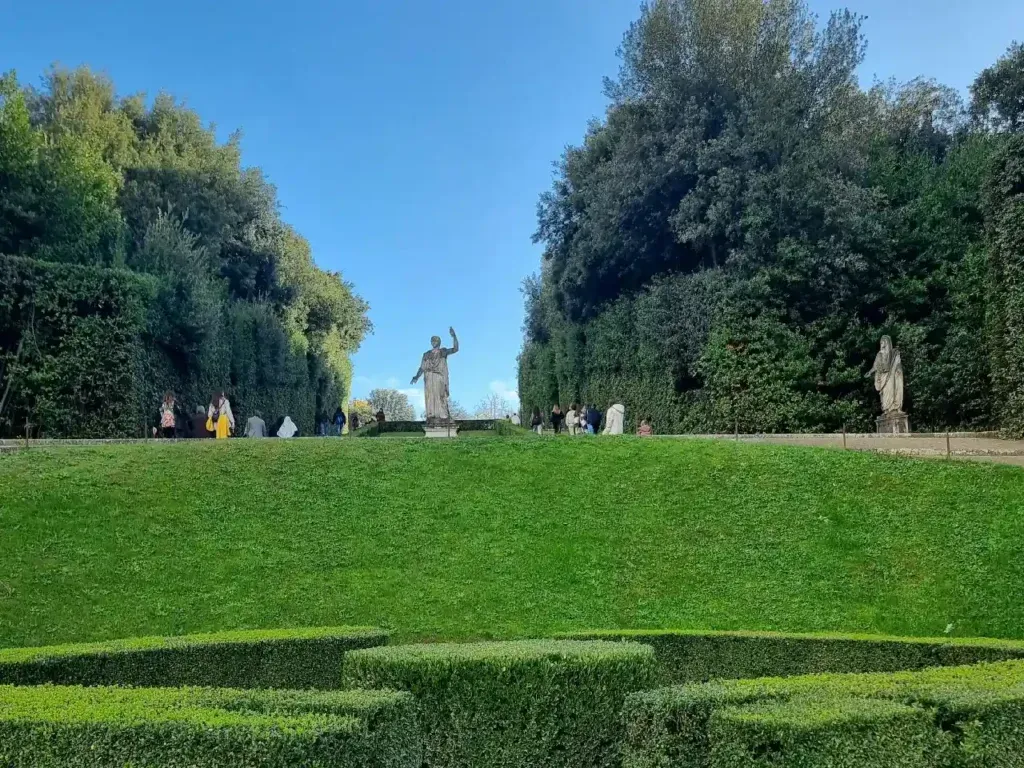
The Boboli Gardens behind Palazzo Pitti
Three set-pieces hold the visitor's attention:
- The Buontalenti Grotto (Grotta del Buontalenti). This three-room artificial cave sits in the far north of the gardens, alongside the entrance to the Vasari Corridor (Corridoio Vasariano). Bernardo Buontalenti redesigned it between 1583 and 1593 into a mannerist tableau of stalactites, painted reliefs, and Michelangelo's Slaves (now replaced with casts; the originals moved to the Accademia).
- The Boboli Amphitheatre. Niccolò Pericoli (Tribolo) arranged the initial green amphitheatre around 1551; Giulio Parigi gave it its present architectural ring between 1630 and 1634.
- The Knight's Building and Rampart (Palazzina e Bastione del Cavaliere). The upper terrace holds the Porcelain Museum and the open views back across Florence: the dome of Santa Maria del Fiore, the Campanile and the tile rooflines of the Oltrarno spread out at eye level.
Inside the Palatine Gallery, the heart of the Medici collection
The Palatine Gallery and the Royal Apartments together occupy the whole piano nobile, and the gallery preserves about 500 paintings displayed exactly as the Grand Dukes hung them, frame against frame on damask walls, under stuccoed Baroque ceilings. Eleven works by Raphael (Raffaello Sanzio) sit at the centre of the collection, which is the largest single concentration of his paintings anywhere; the gallery also holds sixteen panels by Andrea del Sarto, ten by Peter Paul Rubens, three by Caravaggio, and a substantial group by Titian (Tiziano Vecellio), including the cycle of portraits painted for the Medici court.
Five rooms in particular reward a careful pass:
- Sala di Saturno. Raphael's Madonna della Seggiola (also called Madonna della Sedia, oil on panel, around 1513-1514, 71 cm tondo) and the Madonna del Granduca hang here; both define the Sala as the Raphael room of the gallery.
- Sala di Apollo. Titian's Mary Magdalene and his Portrait of a Gentleman anchor a room dedicated to Venetian portraiture.
- Sala dell'Educazione di Giove. Caravaggio's Sleeping Cupid, signed and dated 1608, sets the Baroque tone.
- Sala dell'Iliade. Frescoes by Luigi Sabatelli on the Trojan cycle pair with monumental dynastic portraits.
- Sala di Marte. Rubens's Consequences of War is the gallery's most famous allegorical canvas and his most explicit political statement.
The room order reflects the Medici planetary cycle painted by Pietro da Cortona in the 1640s, an early example of an entire suite designed around a single iconographic programme.
What to see in the Royal Apartments
The Royal Apartments (Appartamenti Reali) run through the south wing of the noble floor, fourteen rooms that read as a continuous timeline of court life between roughly 1620 and 1919. The Medici family redecorated the first series in the early Baroque, the Habsburg-Lorraine grand dukes refitted the central rooms in the late 18th century, and the House of Savoy adapted the last suites after 1865, when the apartments housed the Kings of Italy during Florence's brief tenure as capital.
The rooms preserve their original textiles, gilded mouldings and frescoed ceilings, including the Sala Bianca, a white-and-gold ballroom that today hosts ceremonial events for the Italian state. A long-running restoration cycle means parts of the apartments occasionally close in rotation; opening notices on the Uffizi page list which rooms are accessible on a given day. The combination of three regimes inside one floor is the most direct way to read the political history of Tuscany without ever leaving the same suite of rooms.
The Treasury of the Grand Dukes and the Medici cameos
The Treasury of the Grand Dukes (formerly the Silver Museum) occupies the ground-floor and mezzanine rooms of the Medici summer apartments. These spaces were entirely frescoed for the 1637 wedding of Ferdinando II de' Medici and Vittoria della Rovere, and they form one of the finest cycles of Baroque illusionistic ceiling painting in the city. The Audience Hall, in particular, dissolves the architecture into a painted firmament populated by allegorical Virtues.
The collection inside the rooms ranges from Lorenzo the Magnificent's hardstone vases to court silverware, ivory carvings, ambers, pietre dure cabinets, and a series of cameos and engraved gems that the Medici accumulated across two centuries. The Treasury also includes the so-called Lorraine treasure brought into the palace after 1737, which broadens the material vocabulary into Central European goldsmithing. The mezzanine is occasionally closed for conservation work, and travellers should check daily access before counting on the upper rooms.
Where to see the Macchiaioli at the Gallery of Modern Art
The Gallery of Modern Art (Galleria d'Arte Moderna) sits on the second floor of Palazzo Pitti and runs from Neoclassicism to the 1930s, organised by period through about thirty rooms. Antonio Canova's marbles open the chronology, followed by Francesco Hayez's historical paintings, both representing the conservative academic side of 19th-century Italian art. The collection's most distinctive section belongs to the Macchiaioli, the Tuscan plein-air painters of the second half of the 19th century who pre-empted some of the Impressionist instincts a decade before Paris caught up.
The Macchiaioli rooms display canvases by Giovanni Fattori, Silvestro Lega and Telemaco Signorini, the movement's three central figures, together with related works by Giuseppe Abbati and Vincenzo Cabianca. Many of these pictures entered the gallery through Diego Martelli's bequest, the Florentine critic who hosted the group at his Castiglioncello villa and shaped their early reception. The later rooms move into early-20th-century Tuscan symbolism and post-Impressionism, culminating in works by Plinio Nomellini and Galileo Chini that bridge the gallery's chronology toward the modernist threshold.
What to see at the Museum of Costume and Fashion
The Museum of Costume and Fashion occupies the Palazzina della Meridiana, a separate wing built between 1776 and 1830 alongside the main block. It opened in 1983 as the first state museum in Italy dedicated to historical fashion and currently holds more than 15,000 pieces spanning the 16th century through contemporary haute couture. The display rotates every two years because of conservation limits on textile exposure to light, which means each visit shows a different chronological window.
Two singular holdings ground the collection. The first is the funeral garments of Cosimo I de' Medici, Eleonora di Toledo and their son Don Garzia, recovered from their tombs in San Lorenzo and conserved through a long programme of textile archaeology; the doublets and silk dresses survive in fragments, but enough remains to read the precise tailoring of mid-16th-century court dress. The second is the 20th-century gallery, where a rotating selection of dresses by Mariano Fortuny, Cristobal Balenciaga, Yves Saint Laurent and Giorgio Armani traces how haute couture absorbed and reworked the silhouette over a century.
Inside the Museum of Russian Icons and the Palatine Chapel
The Museum of Russian Icons opened in January 2022 in four previously closed ground-floor rooms next to the Palatine Chapel. The display brings out 78 historical icons, the only such collection in Italy and the oldest known assemblage of Russian sacred art held outside Russia. The icons were gathered by members of the Medici and the Habsburg-Lorraine households across the 18th and 19th centuries, when the Tuscan grand ducal court maintained close diplomatic and dynastic relations with the Russian imperial circle, and they cover schools from Novgorod and Moscow to the late Stroganov workshops.
The rooms themselves were once part of a summer apartment decorated for Grand Duke Cosimo III de' Medici and his bride Marguerite Louise d'Orleans. The largest of the rooms was converted in 1766 into the Palatine Chapel (Cappella Palatina), a private liturgical space for the grand-ducal family. The chapel and the icon display now work as a single visit, and both sit inside the ground-floor entrance, which makes them a practical first stop before climbing to the Palatine Gallery.